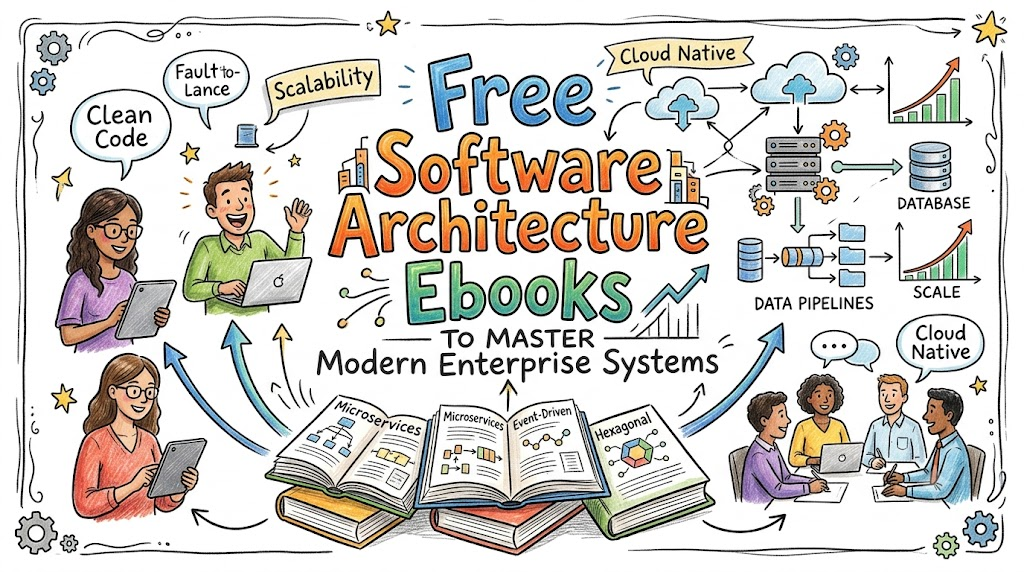
Software architecture serves as the definitive structural foundation for high-performing technical applications. Consequently, system architects design high-level blueprints that dictate data flow, module boundaries, and communication protocols. When technical teams establish clear structural standards, they eliminate performance bottlenecks and ensure long-term system reliability.
Developing robust system design skills allows engineering teams to construct resilient digital solutions that scale under intense workloads. Therefore, mastering architectural patterns and system trade-offs remains essential for developers and technology leads. These engineering concepts bridge the gap between initial code creation and long-term enterprise scalability.
Fortunately, modern developers can study these advanced concepts without spending money on expensive bootcamps. You should explore the comprehensive Freeebooks platform to discover curated technical guides for your engineering career. These digital books present deep practical wisdom regarding distributed services, clean code organization, and fault tolerance.
By consistently reviewing high-level guides, software practitioners learn to evaluate performance compromises effectively. Furthermore, these open educational resources expose engineers to real-world architectures used by leading tech enterprises. Continuous study empowers developers to transition from basic task-oriented coding into influential strategic system leadership.
Understanding Enterprise Software Architecture
Enterprise architecture defines the blueprint of applications, data platforms, and technological infrastructure across organizations. Specifically, it establishes standard rules for how distinct software modules interact and share state across corporate networks. Software engineers must grasp these structural principles to avoid chaotic spaghetti codebases in large codebases.
Moreover, architectural patterns specify non-functional requirements like security boundaries, memory efficiency, and fault tolerance. Without this disciplined approach, rapid feature additions quickly compromise system stability over time. Well-structured architecture acts as the vital bridge between complex business needs and production code.
Core Architectural Patterns and Paradigms
Architectural patterns provide proven templates to solve common structural problems in distributed software engineering. For instance, event-driven designs decouple asynchronous services using event streaming backbones to handle bursty network traffic. Layered architectures isolate user interfaces from backend database operations to maintain clean separation of concerns.
Similarly, microkernel models allow core application engines to extend functionality via hot-swappable plugins. Meanwhile, microservices architectures split monolithic systems into domain-oriented, independently deployable services. Studying these varied blueprints helps architects select optimal frameworks for their unique technical workloads.
Evaluating Trade-Offs in System Design
System design always requires deliberate balance because perfect architectural solutions do not exist in software engineering. As an example, prioritizing immediate data consistency often reduces write availability across distributed database nodes. Conversely, designing for extreme horizontal scalability typically introduces complex eventual consistency challenges across downstream services.
Engineering leaders must carefully assess latency tolerances, development costs, and operational complexity before deploying patterns. Utilizing architectural decision records documents the business context behind these difficult compromises for future engineering cohorts. Thoughtful trade-off analysis separates seasoned system architects from novice developers who chase unproven industry hypes.
The Value of Free Open-Access Guides
Open educational literature plays a transformative role in democratizing software engineering knowledge across the global technology community. Leading system architects frequently release foundational texts, architectural guides, and open manuals to benefit fellow practitioners.
These comprehensive publications unpack intricate case studies covering database sharding, fault recovery, and messaging patterns. Accessing these free guides allows developers from all financial backgrounds to study high-grade enterprise patterns. Consequently, self-directed study using quality open books serves as a direct pipeline to career acceleration.
Key Operational Concepts You Must Know
Distributed State Management
Managing synchronized state across separated networks represents one of the most critical challenges in software engineering. Distributed platforms must synchronize persistent records without causing catastrophic race conditions or deadlocks. Architects frequently employ distributed caching layers alongside resilient transactional databases to balance performance with correctness.
Furthermore, consensus algorithms coordinate distributed nodes during leader elections and state replication tasks. If developers neglect state mechanics, production clusters will eventually produce corrupted customer balances or ghost records. Mastering distributed state principles enables engineers to construct reliable transactional systems that withstand severe network partitions.
Modularity and Loose Coupling
System modularity ensures that distinct application domains remain independent, manageable, and testable throughout their entire lifecycle. To achieve loose coupling, architects establish explicit API contracts and isolate internal service data completely. When teams change an internal database schema, upstream client applications should never break or require urgent redeployment.
Similarly, high functional cohesion ensures that every module concentrates strictly on executing a single business domain. Decoupled services also allow parallel teams to deploy features simultaneously without stepping on shared codebases. This organizational separation maintains high deployment velocity while eliminating cascading failures across the platform.
Observability and Telemetry Architectures
Modern cloud platforms demand automated telemetry pipelines that continuously inspect system health from the inside out. Distributed tracing instruments every individual user request across dozens of microservices to pinpoint latency anomalies. Concurrently, centralized logging platforms aggregate structured diagnostic events to simplify root-cause analysis during outages.
Metrics pipelines capture runtime statistics like garbage collection pauses, queue depths, and memory saturation percentages. When teams integrate deep observability into their architectural designs, they detect subtle performance degradations before outages occur. Ultimately, clear telemetry replaces subjective guesswork with actionable runtime metrics during chaotic production incidents.
Fault Tolerance and Graceful Degradation
Software systems inevitably experience sudden hardware crashes, networking blackouts, and third-party API rate limits. Consequently, resilient architectures implement circuit breakers and exponential backoff retry policies to contain partial failures. These containment patterns prevent failing dependent components from draining application threads and crashing the entire platform.
Additionally, graceful degradation strategies temporarily disable resource-heavy background tasks during high-traffic surges. For instance, an e-commerce platform might deactivate dynamic recommendations to keep the core checkout cart functioning. Designing resilient architectures ensures enterprise services remain partially operational even when severe regional outages strike.
Platform Implementation vs. Culture — What’s the Real Difference?
| Operational Aspect | Platform Implementation Focus | Organizational Culture Focus |
| Primary Goal | Deploying distributed frameworks and infrastructure tooling. | Fostering collective ownership and engineering accountability. |
| Execution Method | Writing orchestration scripts and building automated pipelines. | Mentoring teams, refining standards, and aligning architectural goals. |
| Success Metric | High system throughput and sub-millisecond response latency. | High cross-team trust and rapid autonomous feature shipping. |
| Tool Ownership | Managed primarily by infrastructure and DevOps engineering leads. | Embraced universally by all product developers and business units. |
Technical Tooling vs. Mindset
Adopting modern frameworks like Kubernetes, service meshes, and distributed stream processors is purely a technical undertaking. Engineers can quickly deploy complex infrastructure configurations by applying infrastructure-as-code automation templates. However, purchasing or configuring sophisticated software tools never automatically resolves fundamental systemic engineering dysfunction.
If the engineering organization lacks design discipline, they merely produce distributed monoliths that are harder to maintain. Technical tooling provides the machinery, but thoughtful human design governs long-term enterprise sustainability. Therefore, platforms remain ineffective unless paired with deep developer comprehension and structured practices.
Building Architectural Alignment
A resilient architecture cannot thrive within an organization that discourages open technical discussion and trade-off debates. Progressive engineering organizations encourage developers to question legacy design patterns and propose modular improvements. Furthermore, these collaborative teams actively conduct blame-free post-incident reviews to convert production failures into shared knowledge.
When companies prioritize continuous learning, developers instinctively embrace clean code practices and comprehensive architectural documentation. Culture transforms passive coders into proactive architects who care deeply about cross-system reliability. Consequently, strong engineering values guarantee that platform investments yield enduring business agility and high product quality.
Real-World Use Cases of Modern Operations
High-Volume Financial Processing
Global payment gateways process millions of transactions per second while maintaining strict regulatory compliance. These mission-critical systems implement event-driven architectures backed by distributed transactional ledgers to log immutable payment events. Furthermore, architects utilize deterministic state machines to ensure that money transfers never duplicate during dropped connections.
By applying micro-segmentation and tokenization patterns, financial platforms isolate sensitive customer payment information from other services. This layered architectural approach satisfies stringent auditing requirements without compromising end-to-end processing latency. As a result, customers experience instant payment confirmations while the banking infrastructure prevents fraudulent activities.
Global Content Streaming Networks
Video streaming platforms distribute terabytes of rich media across globally distributed points of presence daily. In order to minimize buffering, system architects rely heavily on edge computing nodes that serve media files. These edge services leverage intelligent caching algorithms to store popular shows near end users geographically.
Behind the scenes, adaptive bitrate algorithms dynamically alter video resolution based on the user’s connection strength. Meanwhile, resilient microservices handle real-time user authentication and billing updates asynchronously across central cloud datacenters. This hybrid edge-and-cloud architecture maintains uninterrupted streaming playback even across congested residential networks.
- Principal Enterprise Architect: Designs multi-region disaster recovery policies and approves enterprise data topologies.
- Domain Service Lead: Manages bounded contexts, optimizes microservice interfaces, and enforces domain rules.
- Infrastructure Reliability Engineer: Implements automated failover mechanisms and monitors global network saturation.
Intelligent Autonomous Logistics
Global shipping enterprises direct fleets of delivery vehicles and coordinate automated fulfillment warehouses around the clock. System architects design real-time routing engines that ingest traffic feeds, weather updates, and vehicle sensor readings. These asynchronous ingestion pipelines route sensor telematics into streaming analytical frameworks to recalculate optimal delivery routes.
Within automated warehouses, distributed event brokers manage autonomous sorting robots that package customer orders. If an individual robotic unit suffers a mechanical breakdown, adjacent machines instantly claim unfinished tasks. Therefore, real-time event routing prevents inventory gridlocks and guarantees precise delivery estimates for retail clients.
Common Mistakes in Operations Engineering
Premature Distributed Microservices
Junior developers often jump directly into microservices architecture before understanding the actual business domain boundaries. Carving an application into dozens of network-separated services prematurely introduces immense network latency and deployment overhead. Teams quickly discover that simple data joins now require distributed sagas and complex two-phase commits.
Instead of gaining deployment velocity, the organization becomes trapped managing network failures and tracing scattered logs. Monoliths remain significantly easier to refactor, test, and reason about during early product iterations. You should always begin with a modular monolith and split services only when organizational scaling demands it.
Accumulating Unaddressed Technical Debt
When product managers rush feature deliveries, engineers often bypass architectural boundaries to meet pressing quarterly deadlines. Consequently, teams take shortcuts like hardcoding database queries inside presentation components or bypassing integration tests. While these compromises might accelerate immediate feature releases, they accumulate dangerous technical debt across the platform.
Eventually, the entire codebase degrades into a brittle environment where trivial modifications trigger widespread outages. Engineering leaders must actively allocate dedicated sprint capacity to refactor deteriorating modules and upgrade dependencies. Systematically addressing architectural debt preserves engineering morale and keeps feature development speeds consistently sustainable.
Critical Architecture Warning: Never sacrifice foundational design patterns or integration testing to meet arbitrary product release deadlines. Rushing unvetted, tightly coupled code into production inevitably causes catastrophic cascading outages that cost exponentially more to repair.
Treating Observability as an Afterthought
Many software teams build complex distributed topologies without incorporating monitoring tools until severe production disasters strike. Attempting to retrofit distributed tracing and structured telemetry into live enterprise systems is remarkably painful and expensive. Without detailed runtime telemetry, engineers spend days hunting down transient networking glitches or memory leaks manually.
Architects must treat observability as a first-class citizen alongside business logic from day one of development. Standardize logging formats, error codes, and metric definitions across all participating repositories before writing business workflows. Establishing deep system visibility early ensures rapid debugging and safeguards system health throughout future architectural changes.
How to Become an Operations Expert — Career Roadmap
Mastering Fundamental Patterns
Your educational journey must begin with mastering classic design patterns and clean code principles thoroughly. Study foundational architectural styles including layered systems, hexagonal patterns, and clean architecture abstractions across popular programming languages. You must understand how dependency inversion and interface segregation isolate business logic from database frameworks.
Next, dedicate time to reading free online architectural books that explain concurrency, thread pools, and memory allocation. Write hands-on sample applications to explore these patterns and test their limitations under artificial stress loads. Building an unshakeable grasp of structural fundamentals gives you the confidence to tackle modern distributed systems.
Designing Scalable Distributed Topologies
After conquering monolithic design principles, progress directly into distributed computing theory and cloud infrastructure designs. Learn the mathematical fundamentals of distributed consensus algorithms, gossip protocols, and the CAP theorem tradeoffs. You should practice designing scalable data architectures that utilize database partitioning, read replicas, and caching topologies.
Gain practical experience configuring message queues, event brokers, and reverse proxies to coordinate microservice communication flows. Analyze how real-world enterprises partition their customer databases to support high transaction volumes without degraded performance. Mastering distributed design enables you to architect systems that scale gracefully across multi-region cloud infrastructures.
- Junior Software Developer: Focuses on writing clean code, implementing unit tests, and adhering to established structural guidelines.
- Senior Systems Designer: Models bounded domains, designs robust data schemas, and establishes microservice interface contracts.
- Chief Technology Architect: Sets corporate technical standards, evaluates enterprise frameworks, and guides high-level technical strategy.
Mastering Strategic Communication and Trade-Offs
Technical capability alone is insufficient to thrive as a respected enterprise software architect in major organizations. You must master the craft of articulating complex architectural trade-offs to business executives and non-technical stakeholders. Learn to draft clear Architectural Decision Records that explain why specific technologies were selected over popular alternatives.
Additionally, mentor junior software engineers through empathetic design reviews, system diagramming sessions, and collaborative pair-programming exercises. Great architects influence their organizations through transparent reasoning, clear blueprints, and mentorship rather than authoritarian commands. Bridging technical implementation with strategic business value will position you as an indispensable technology leader.
FAQ Section
- What is the best way to begin learning software architecture using free online ebooks?Start by selecting foundational books that teach design patterns, SOLID principles, and clean modular code organization. Once you master basic structural concepts, advance toward specialized literature covering distributed systems, microservices, and database partitioning.
- When should an engineering team migrate from a monolithic architecture to microservices?You should migrate only when your modular monolith faces severe team-scaling bottlenecks or distinct computational scaling requirements. If multiple engineering squads cannot deploy code independently without stepping on shared repositories, decoupling services becomes justified.
- How do architectural decision records benefit long-term software engineering projects?Architectural decision records capture the context, alternatives, and trade-offs behind critical structural choices made during system construction. Consequently, incoming developers understand why specific patterns exist, preventing accidental rollbacks of intentional architectural compromises.
- Can I become a successful system architect without holding a formal computer science degree?Yes, you can build a successful architecture career through dedicated self-study, reading open guides, and hands-on practical design experience. Mastering core concepts like concurrency, database management, and network protocols through open educational resources provides all required knowledge.
- Why is data consistency such a difficult challenge in modern distributed systems?Distributed systems partition data across multiple physical machines separated by networks that periodically drop packets or experience latency. Because instantaneous network synchronization is physically impossible, systems must carefully balance immediate consistency against high availability.
Final Summary
Developing software architecture capabilities empowers engineers to build resilient, maintainable, and high-performance digital platforms. By choosing modular designs and clean patterns, developers protect their applications against premature obsolescence and technical debt. However, successful system implementation requires balancing robust infrastructural automation with a healthy organizational culture that values continuous improvement. Avoid the temptation to overcomplicate early applications with premature microservices, and prioritize observability throughout your engineering workflows.
As you advance your technical journey, continue studying distributed state mechanics, fault containment patterns, and non-functional system attributes. Consuming high-quality educational publications will continuously sharpen your structural thinking and accelerate your career trajectory. Dedicate yourself to ongoing learning, experiment with diverse architectural patterns, and lead your engineering teams toward constructing enduring enterprise platforms.